
Everett Previous Residents by Era
Each source sees a different part of an Everett address. Deeds establish transfers of land interests. Directories and census records identify occupants at a date. Maps test whether the same lot held the same building. Permits, obituaries, cemetery material, and probate files may explain a change that the main chain cannot.
| Source | Years covered | Where held | What it shows |
|---|---|---|---|
| County deed index | Most records July 1976 to present | Snohomish County Auditor portal | Grantor, grantee, instrument, date, ARN, legal description |
| Pre-1976 deeds | Before July 1976 | Auditor microfilm, counter, staff, Archives | Older parties and legal descriptions; images vary |
| Polk directories | 1893 to 1999 | Everett Public Library | Name, address, occupation, family and phone clues |
| Federal census | Public through 1950 | NARA and library databases | Household at the enumeration date |
| Sanborn maps | 1892 to 1914; updates through 1955 | Everett Public Library | Building footprint, use, lot and street context |
| Everett permits | Historical start not verified | Digital Records Center, eTRAKiT, city request | Construction, remodel, occupancy and utility clues |
Start with the newest reliable source and work backward. The parcel and deed chain control land identity. Occupant sources add people, while maps and dated records test whether the structure and address remained continuous.
The Washington State Library provides a second directory run with gaps from 1901 through 2008. Its catalog can test whether a missing Everett Public Library year exists elsewhere. The State Library closed to ordinary public access in 2025, so research is catalog-first and appointment based. State Library dates should not be merged into the Polk run or used to claim one publisher for every volume.
Save the Everett Parcel First
Open the Snohomish County Assessor account before searching past residents. Save the current situs address, parcel number, legal description, taxpayer, map, transfer history, and structure clues. A situs address locates the property. A mailing address only tells where tax notices go, and those fields may differ.
The parcel number and legal description are stronger bridges than street text. A road can be renamed, a number can change, and a parcel can split or combine. SCOPI may label a selection as multiple parcels or shared interest, so check each associated account. Preserve the street address, parcel number, and legal description at every stage.
Also save the tax year displayed on the account. Value history and transfer tabs can point toward a period of change, but they are not substitutes for the deed. If the account shows a mailing address outside Everett, keep that field under its own label. It may help distinguish two owners with the same name, though it never proves where the taxpayer lived.
Trace Everett Owners Through Deeds
The Snohomish County Recorded Documents Search turns the current taxpayer into a backward chain. A grantee receives an interest; a grantor conveys one. Match the legal description at each link because a common name may appear in unrelated transactions.
- Copy the owner, parcel number, and legal description from the Assessor account.
- Search the owner as grantee and open the newest matching deed.
- Record both parties, instrument type, date, recording number, and legal wording.
- Search that grantor as a grantee to find the prior transfer, then repeat.
- Resolve parcel splits, probate transfers, trusts, or changed descriptions before continuing.
- Grantor
- The party conveying an interest in property.
- Grantee
- The party receiving that interest.
- Chain of title
- The linked sequence of conveyances for the same land.
- Legal description
- The recorded land description used across changing addresses.
Read Everett Instruments by Role
A deed or quitclaim deed can transfer an interest. A deed of trust or mortgage secures an obligation. A reconveyance can release that security. Liens and lis pendens give notice of claims or pending litigation but do not prove ownership. The index is not a title opinion and may not resolve trusts, releases, probate conveyances, or unrecorded interests.
Search by name, document type, recording number, date, parcel ID, book and page, or legal description. County guidance says to use the first 10 parcel digits. Search names as “Last Name, First Name,” then run spelling variants. Online previews are unofficial. Certified and nonwatermarked copies must be purchased.
The Auditor also records plats and surveys. These documents can bridge an old lot and block to a current parcel when the street number has changed. Save book and page references whenever they appear. If a deed only names an addition or subdivision, search that phrase and compare its plat geometry with SCOPI before attaching a person to the modern address.
Everett Deeds Before July 1976
Most recorded documents from July 1976 forward are online. Earlier Everett deeds require another route. Use microfilm and public terminals at the Auditor, ask for staff research by phone, or mail a request. The Recording Division is at 3000 Rockefeller Avenue, Everett, and its phone is 425-388-3483. Significant staff time or pre-1976 work can cost $8 per hour.
Washington Digital Archives adds a land series with 6,019,654 records and some images. That count does not promise every Everett deed image. Confidential images are withheld. The exact oldest grantor-grantee book year was not verified, so use the index, microfilm, Archives, and staff together when the chain reaches the gap.
Everett Library Rebuilds House History
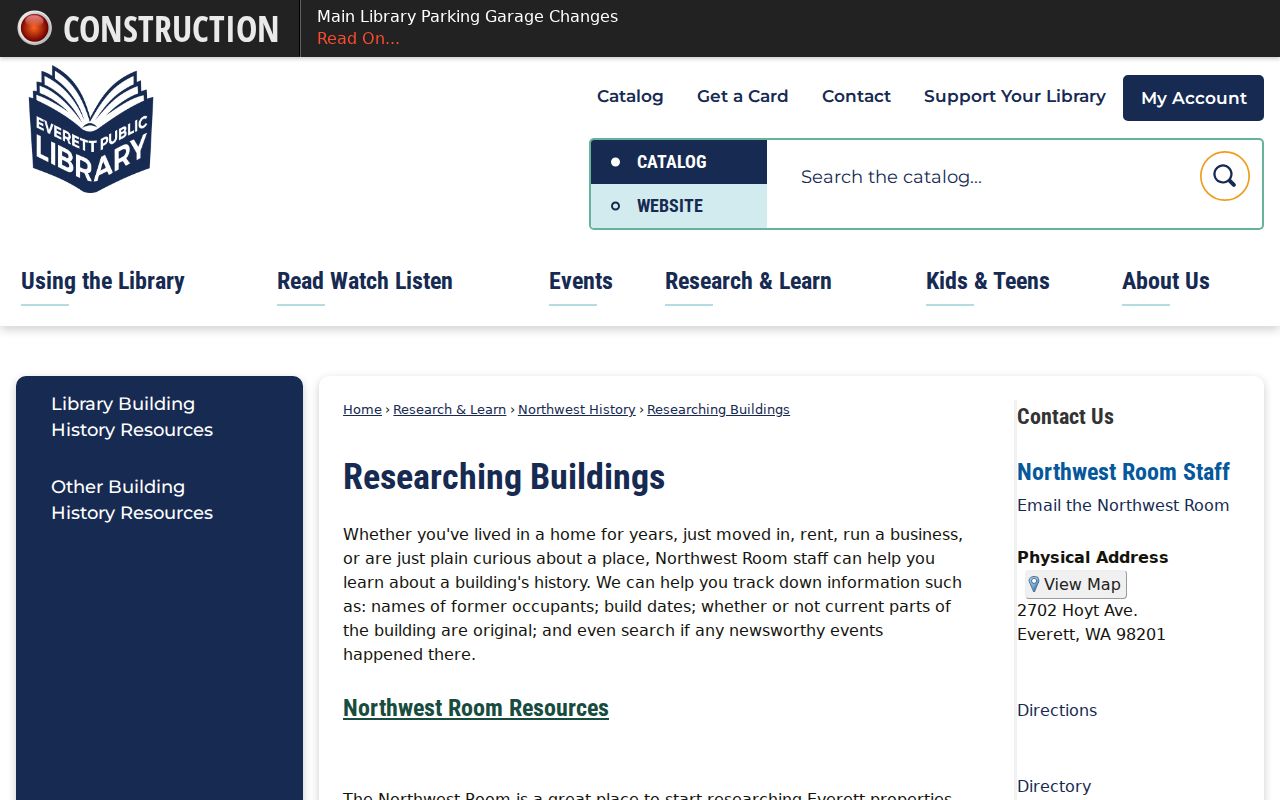
The Everett Public Library building-history guide combines maps and directories to find former occupants, build dates, and original parts. It warns that early county permits were not retained and blueprints are not on file. A focused permit request may still find later work, but no complete construction file should be promised.
The library guide shown below is a local starting point for learning who lived here before.
The Northwest Room is closed to in-person research during renovation through Fall 2026, yet staff scans and research requests continue. Reference directories near the second-floor desk are less complete but can still support house research.
Historic Everett suggests pairing the Northwest Room's Polk volumes with house files, yearbooks, photographs, and maps. Its workflow starts with names and addresses rather than a broad story about the structure. Record the source and year for every occupant name. A photo caption, business line, or school entry can support identity, but it should remain distinct from proof of ownership.
Everett Sanborn Maps Test Continuity
Everett Public Library's Sanborn maps cover 1892, 1893, 1902, 1904, and 1914, with pasteover updates through June 1955. They show footprints, uses, lots, and streets. A vacant lot on one sheet and a dwelling on the next can narrow a build period. Sanborn does not name residents, so pair its physical evidence with a directory or census entry.
The library's Sanborn screen below leads to dated building and lot views.
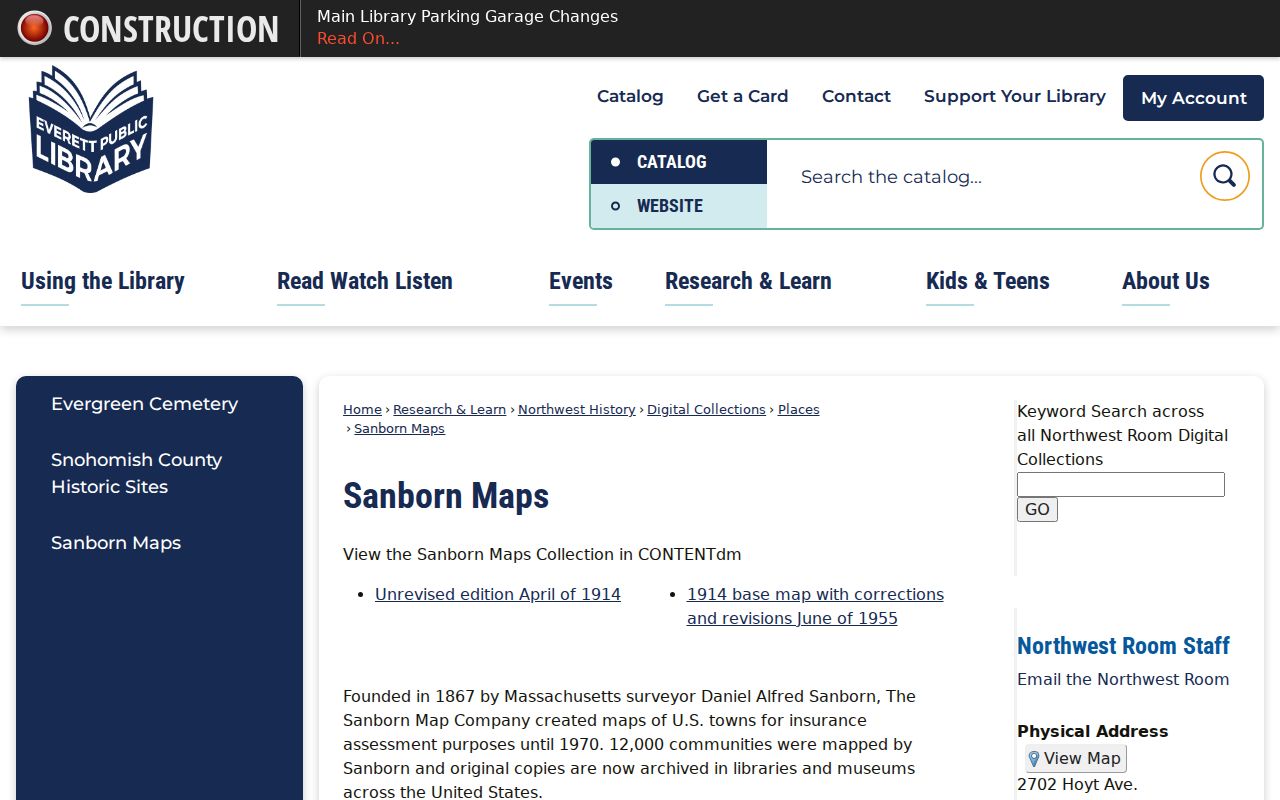
Read pasteovers as updates to an earlier base sheet, not automatically as a new map year. Compare the key, sheet date, lot, and building outline.
Pair Everett Directories and Census
Polk directories held by Everett Public Library span 1893 through 1999. A householder address index begins in 1932. The federal census is public through 1950 under the 72-year rule and records a household on its enumeration date. Directory publication dates and census dates are different observations, so a name between them may reflect a move rather than an error.
- Choose a directory year near the census and copy the printed address exactly.
- Use the address index, or the surname section for earlier years, to list occupants.
- Find the census household and record names, ties, ages, and occupations shown.
- Compare nearby directory years to bracket arrivals and departures.
- Confirm that the legal description and map footprint still identify the place.
The full shelf belongs to the Everett city directory. For previous residents, focus on how each dated entry fits one address.
The digitized 1900 Everett and Lowell directory adds a local caution. Its original fields distinguish “res,” “bds,” and “rms,” while an enhanced transcription corrects spellings and expands business names. The transcription is helpful for finding a name but is not exact. Compare the original image before quoting a printed address or deciding that two spellings refer to different people.
Close Everett Resident Gaps Carefully
When a name disappears, search the Everett Daily Herald archive, Evergreen Cemetery material, and Snohomish County probate files. The Herald archive reaches through December 2023 via library access. Staff obituary requests work best with a name and exact death date and can return a PDF. Evergreen Cemetery was platted in 1898 and holds roughly 50,000 interments, making it a strong name and date lead.
Probate may explain an abrupt deed transfer or identify heirs, but the County Clerk controls those files. Court records are not Public Records Act requests. Use a case name or number, view permitted material at the counter, or mail the Clerk's copy form. Treat an obituary, burial record, probate file, and deed as separate sources that support one another.
Everett Boundaries Change Address Labels
Snohomish County formed in 1861, while Everett incorporated in 1893. County deeds can predate the city. Everett has completed 88 annexations, and its history map groups them across periods through 2016. An older directory may place the same land under a county or community name.
The 2026 southern annexation study concerns about 4,850 acres and 48,000 residents, including Mariner, but it is not a completed change. Record the jurisdiction and date in each source. A parcel's legal identity may persist while its city label, permit office, or municipal record keeper changes.
Use Everett Previous Residents Lawfully
Deeds identify parties to land records, not every occupant. A directory is a dated publication, and a census captures one enumeration date. Protected voter addresses, current vital records, driver data, and utility customer details are closed or limited. Never fill those gaps by treating a taxpayer mailing address as a home address.
Label each fact by its source and role. Owner, taxpayer, grantor, grantee, directory occupant, and census household member are not interchangeable. That discipline makes an Everett previous residents timeline useful for genealogy, estate work, and personal house research without overstating the evidence.
Lawful use. Research past residents for lawful personal and historical purposes only. Never use address records to stalk, harass, threaten, or harm a person.